
Modular plastic belt conveyors for food processing and manufacturing. Explore belt types, applications, advantages and key factors for choosing the right conveyor.
In food processing, a conveyor may have to operate in wet conditions, undergo regular cleaning and handle products at different temperatures. In such environments, a conventional conveyor belt is not always the most practical solution.
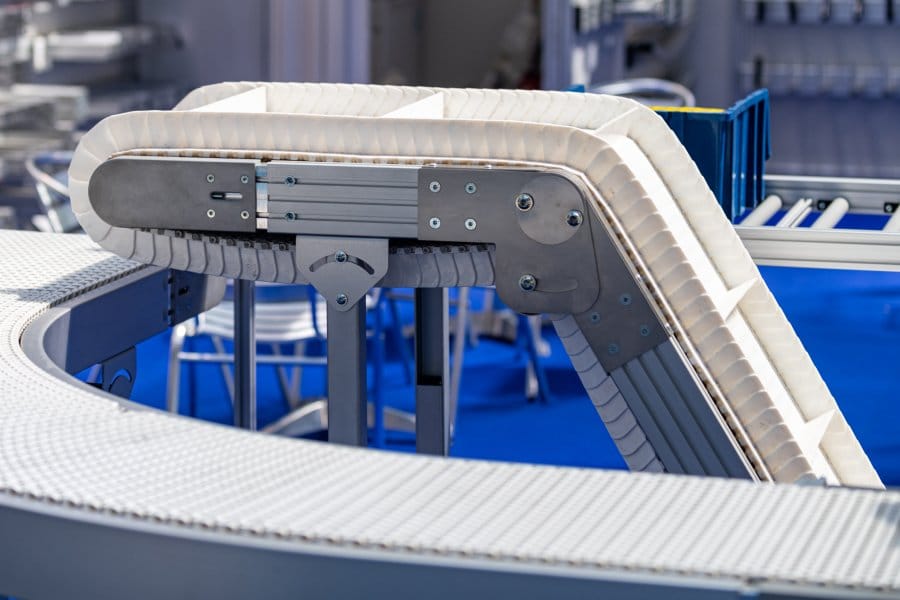
A modular belt conveyor uses a belt made of individual plastic modules connected by hinge rods.
This design makes it possible to adapt the conveying surface to the process. The belt can have a closed or open surface, include flights for inclined conveying, allow water drainage or be designed for curved conveyor layouts.
How does a modular belt conveyor work?
Unlike many conventional belt conveyors that rely primarily on friction between the belt and drive pulley, modular plastic belts are generally driven by sprockets engaging directly with the belt.
A typical system includes:
- a modular plastic belt;
- drive and return shafts;
- sprockets;
- a geared motor;
- conveyor frame;
- wear strips and guides;
- side guides and flights where required.
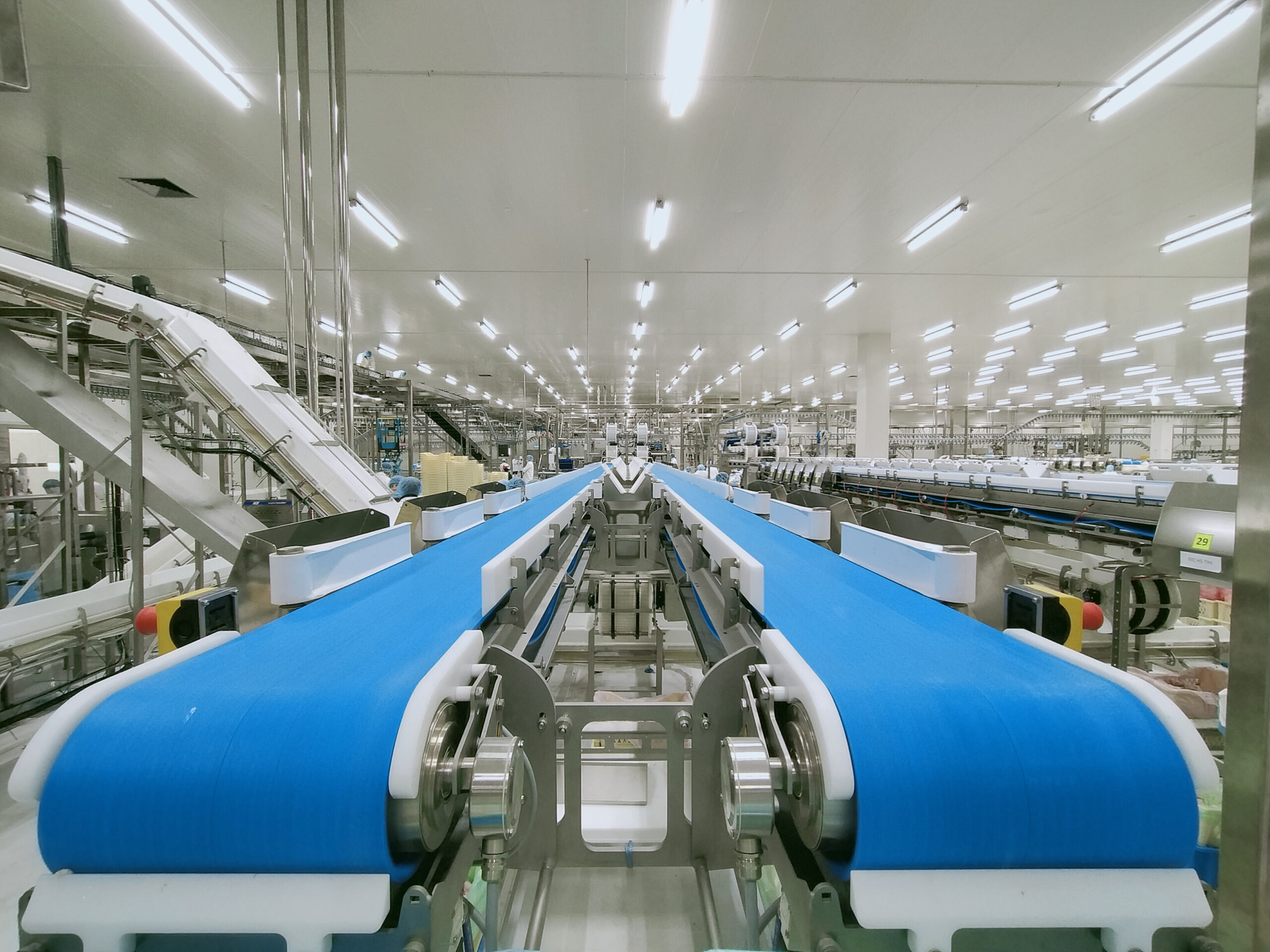
For food-processing applications, stainless steel is commonly used for the conveyor structure and relevant product-contact areas.
Main types of modular conveyor belts
Flat Top belts provide a relatively closed, stable conveying surface. They can be used for packaged products, containers, bakery products and other items requiring stable support.
Flush Grid belts have an open structure that allows water and air to pass through. This makes them useful after washing processes, during cooling or where excess liquid needs to drain away.
Open-surface belts provide greater airflow through the conveying surface and can be used in certain cooling, drying and freezing processes.
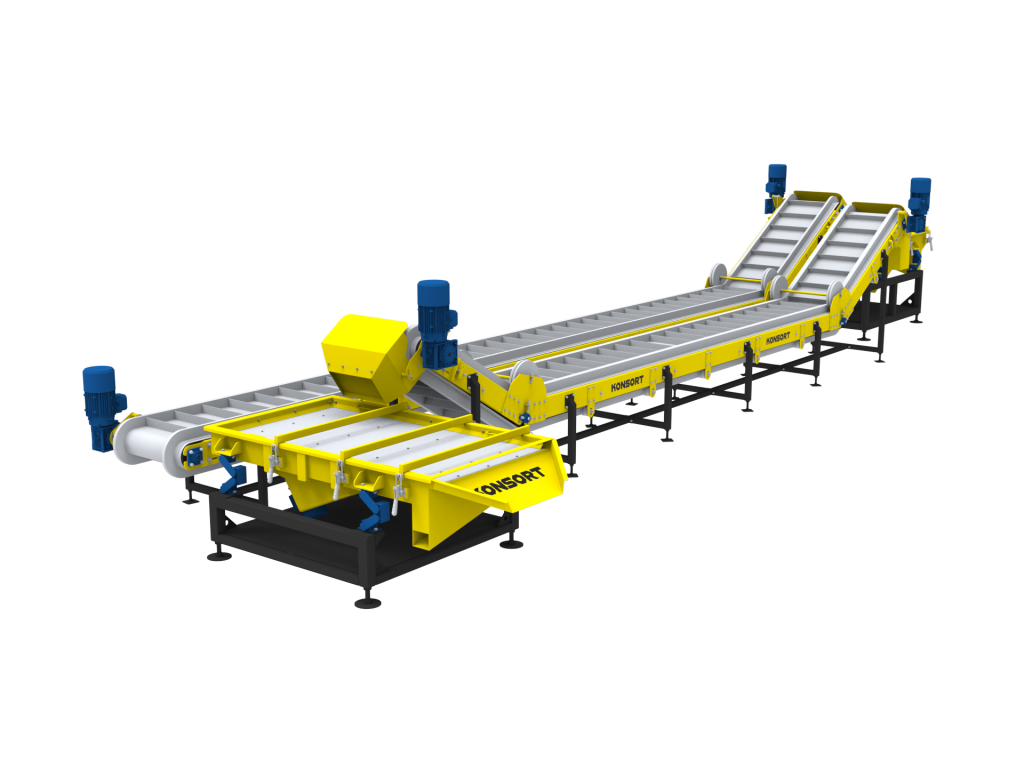
Modular belts with flights help prevent products from sliding backwards on inclined conveyors. They are commonly used for vegetables, fruit, frozen foods and other loose or individual products.
Radius modular belts make it possible to build curved conveyor sections and change the direction of product flow without creating a separate straight conveyor for every section.
What products can be transported?
Modular conveyors are widely used for:
- potatoes and root vegetables;
- fruit;
- meat and meat products;
- fish;
- frozen foods;
- bakery products;
- confectionery;
- containers and trays;
- packaged finished products.
They are particularly useful where transportation is combined with another process such as washing, draining, cooling, inspection or feeding products into processing or packaging equipment.
Modular belt or conventional conveyor belt?
A modular plastic belt is not automatically better than a PVC or PU belt.
For dry packaged products or simple transportation tasks, a conventional belt conveyor may be more economical.
A modular system becomes particularly valuable when the process requires:
- operation in wet conditions;
- water drainage;
- an open conveying surface;
- inclined conveying with flights;
- curved conveyor layouts;
- local replacement of damaged belt modules;
- integration into a processing line.
The ability to replace individual modules can also reduce the scope of repairs when only a section of the belt is damaged.
What are the limitations?
Modular belt conveyors generally have a higher initial cost than simple conventional belt conveyors.
Cleaning also requires careful consideration. Although modular plastic belts are widely used in food processing, joints, hinges and openings can collect product residues if the belt and conveyor are not designed for effective sanitation.
Temperature is another important factor. Polypropylene, polyethylene and acetal have different mechanical and thermal properties, so the belt material must be selected for the actual operating conditions.
Choosing the right modular conveyor
The selection process should start with the product.
Key parameters include:
- minimum and maximum product dimensions;
- weight;
- operating temperature;
- moisture;
- required throughput;
- cleaning requirements;
- conveyor speed;
- incline or curve requirements;
- upstream and downstream equipment.
For example, washed potatoes may benefit from an open modular belt that allows water to drain through the conveying surface.
Small confectionery products require particular attention to transfer gaps.
Frozen foods require a belt material suitable for the operating temperature.
There is no single modular belt that is ideal for all three applications.
From a conveyor to a complete production line
The real value of conveyor automation becomes clear when individual machines are connected into one controlled product flow.
A processing line may look like:
washing → modular conveyor → inspection → grading → weighing → packaging.
Another process may require:
processing → conveying → cooling → quality control → packaging.
In both cases, the conveyor does more than move the product. It connects individual processes and helps maintain a consistent production flow.
KONSORT develops straight and curved modular belt conveyors as well as complete conveyor systems for food processing, agricultural products and industrial applications.
Conclusion
A modular belt should not be selected simply because it is considered a more advanced conveyor technology.
It should be selected when its design solves a specific production problem.
For one plant, that may be water drainage after washing. For another, it may be inclined conveying. For a third, the main advantage may be easier replacement of damaged belt sections or the ability to build a curved conveyor route.
The right modular conveyor therefore starts with understanding the product, operating conditions and entire production process — not simply choosing a belt from a catalogue.
FAQ
What is a modular belt conveyor?
It is a conveyor that uses a belt assembled from individual plastic modules connected by hinge rods.
Where are modular conveyors used?
They are widely used in food processing, fruit and vegetable processing, meat and fish processing, frozen food production, packaging and other industrial applications.
Can modular belts be used for direct food contact?
Yes, provided that the selected belt material is suitable and documented for the intended food-contact application.
Are modular belts suitable for wet products?
Yes. Open or perforated modular belts can be particularly useful where water needs to drain through the conveying surface.
Which is better: a modular belt or a PVC belt?
Neither is universally better. The correct choice depends on the product, environment, sanitation requirements and conveyor layout.
Can individual belt modules be replaced?
Yes. Damaged sections can generally be repaired by replacing individual modules rather than the entire belt.
Can a modular conveyor be custom-built?
Yes. Conveyor dimensions, belt type, speed, frame material and additional components can be designed around the specific production process.