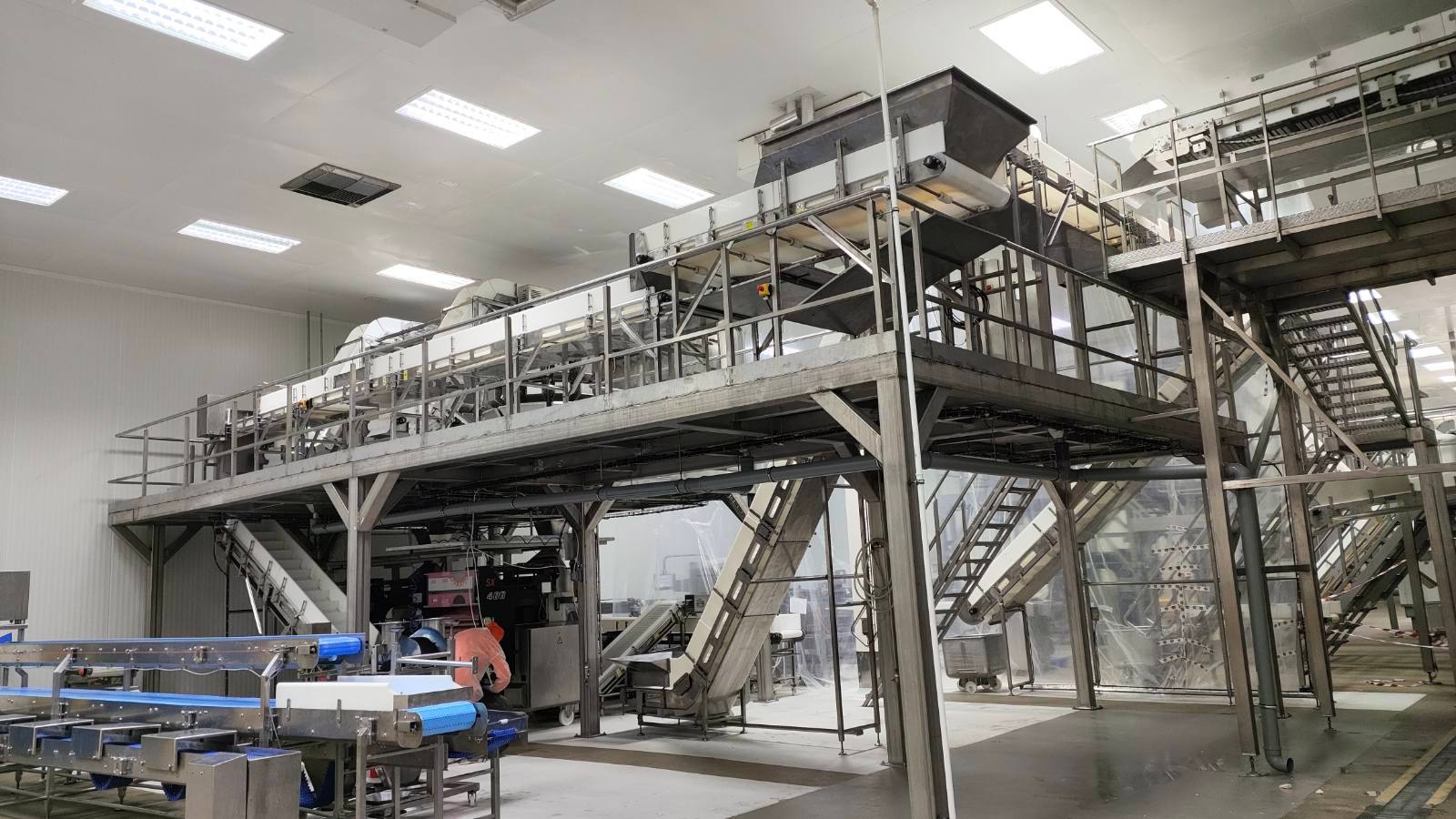
After washing, produce is wet — and that is a problem. Moisture on apples or carrots ruins paper packaging, speeds up mould, and gets in the way of weighing and labelling. That is why a modern washing line is not just a tank with brushes but also a drying unit. KONSORT builds bubble washers with two drying options: fans and air knives. Here is how they differ and which one fits your process.
Contents:
- How a bubble washer works
- Option 1: fan drying
- Option 2: air knives
- Comparison: fan or air knife
- Case: apple line for MTB Alliance
- Case: vegetables for the Tavria-V chain
- How to choose a drying option
- FAQ
How a bubble washer works
Produce enters a water tank. A compressor feeds air into the bottom of the tank, creating a stream of bubbles (aeration) that gently tumbles the product and removes dirt without impacts or scratches. Depending on the configuration, rotating brushes then do their job, and at the outlet a nozzle module rinses the product with clean water. An inclined conveyor with a perforated modular belt lifts the product out of the tank while water drains through the perforation. This outlet is exactly where you decide how to remove the remaining moisture.
Option 1: fan drying
Axial fans are mounted above the conveyor, usually in a hood over the belt. They create a general airflow with a large volume over a wide area. The product travels under the flow and gradually dries.
Advantages:
- simple design and lower cost;
- low operating costs and easy maintenance;
- gentle blowing — suitable for delicate products;
- even coverage across the full belt width.
Limitations:
- the air disperses — drying needs a longer conveyor section or lower speed;
- less effective at removing water from recesses and dense product layers.
Best for: partial drying, cooling, lines with spare length, products that only need the bulk of the water removed.
In the catalogue: conveyor for blow-drying products (partial drying) — from UAH 240,000.
Option 2: air knives
An air knife is a hollow profile with a narrow slot across the full belt width. A blower (compressor) feeds air into it, and a thin, concentrated stream — an “air blade” — comes out of the slot. It literally strips droplets off the product surface.
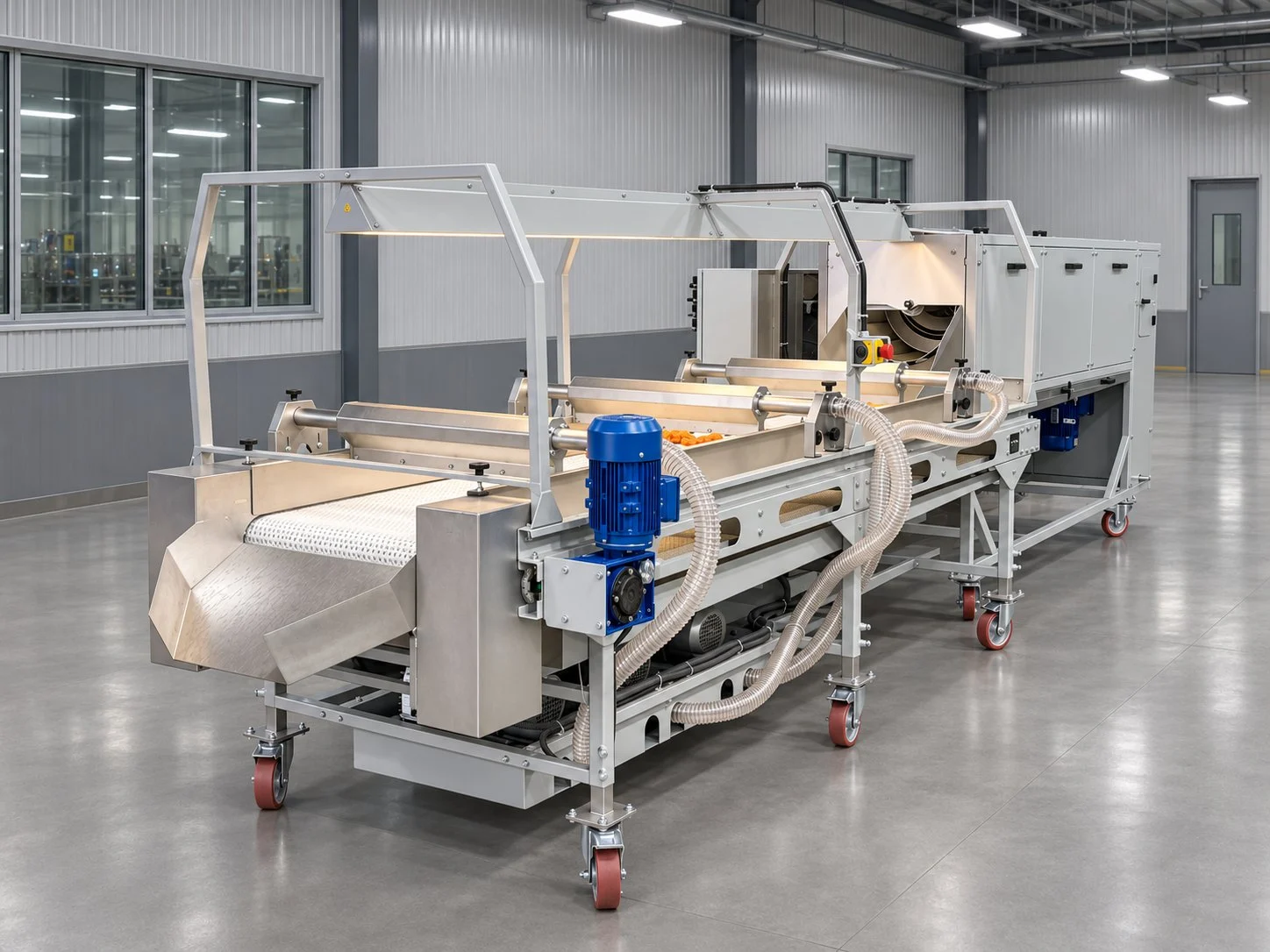
Advantages:
- efficient moisture removal without heating the product;
- compact unit — less line length needed;
- the flow can be aimed at the right angle and zone;
- works well with round produce: apples, root vegetables, onions.
Limitations:
- requires a blower — higher upfront cost and energy use than fans;
- knives must be set up correctly for the product and belt speed.
Best for: product that goes on to packing (including paper bags), weighing or labelling; limited floor space; when consistently dry product is required.
In the catalogue: bubble washer with inclined conveyor and air knife — from UAH 667,500; vegetable line: washer + air-knife conveyor — from UAH 880,000.
Comparison: fan or air knife
| Parameter | Fans | Air knives |
|---|---|---|
| Airflow type | General, wide | Concentrated, narrow |
| Drying efficiency | Partial | High |
| Drying section length | Longer | Shorter |
| Product heating | No | No |
| Equipment cost | Lower | Higher (blower required) |
| Energy use | Lower | Higher |
| Best choice for | Partial drying, cooling | Product before packing and weighing |
Not sure what suits your product? A KONSORT engineer will select the right option free of charge.
Case: apple line for MTB Alliance
For MTB Alliance LLC, KONSORT built a complete apple washing and drying line with a capacity of up to 2,000 kg/h. After processing, the apples are packed into paper bags, so dry product was critical.
- Bubble washer — gently cleans apples with air flows and three rotating brushes, followed by a final clean-water rinse. A 35° inclined conveyor with a 600 mm perforated modular belt, speed controlled by a frequency inverter. At the outlet — an air knife of our own manufacture.
- Inspection conveyor with three air knives — 1,000 mm belt, 2.8 m long, 0.3 m/s, LED lighting for quality control. The knives remove residual moisture and prepare the apples for packing.
- Rotary accumulation table, Ø1,200 mm with rubber lining — buffers apples for packing without stopping the line.
More: apple washing and drying line case for MTB Alliance.
Case: vegetables for the Tavria-V chain
The Tavria-V supermarket chain had planned a large integrated line but decided to launch it step by step without overspending. KONSORT engineers proposed replacing felt-roller drying with air knives — showed how it works, calculated the cost, and the client agreed. For KONSORT this is the first completed project of an air-knife inspection table for root vegetables.
- Brush washer 2,880 × 650 × 1,825 mm, 1 t/h — for carrots, potatoes and beetroot.
- Inspection table 3,000 mm long, 800 mm working width, 3 air knives with a compressed-air supply: the operator removes rejects, the knives blow off residual water.
- Product-contact zones are food-grade stainless steel, the support frame is painted steel. The equipment was shipped at the end of December 2025.
Result: product leaves the line clean and dry, ready for packing or further processing — with minimal equipment costs.
How to choose a drying option
- What happens to the product next? Packing, weighing, labelling — choose air knives. Further wet processing or cooling — fans will do.
- What shape is the product? Round produce (apples, root vegetables) dries well with knives; flat and light products are better blown more gently.
- How much floor space do you have? Knives deliver results on a short section.
- What is the budget? Fans are cheaper upfront; knives save on packaging rejects and floor space.
Read also: brush or bubble washer — which to choose.
FAQ
What is the difference between an air knife and a fan?
A fan creates a wide, general, high-volume airflow. An air knife pushes air through a narrow slot, producing a thin, concentrated stream that strips droplets off the product more effectively over a short section.
Does an air knife heat the product?
No. Water is removed by airflow, not heat, so the product is not warmed — important for fresh fruit and vegetables.
What should I choose for apples packed into paper bags?
Air knives: they deliver consistently dry product. This is how the up to 2,000 kg/h line for MTB Alliance was built.
Can air knives replace felt-roller drying?
Yes. For the Tavria-V chain, KONSORT replaced felt-roller drying with an inspection table fitted with three air knives.
How much does a bubble washer with an air knife cost?
A bubble washer with inclined conveyor and air knife starts from UAH 667,500; a fan drying conveyor from UAH 240,000. An engineer calculates the exact price for your product and capacity.
Tell us about your product and capacity — we will prepare a 3D design and a commercial offer.