Automating a meat processing facility involves much more than installing conveyors between processing stages. It requires maintaining a continuous product flow, synchronizing equipment, distributing products between production areas, and meeting strict food safety requirements.
KONSORT delivered this integrated solution for the Myronivka Meat Processing Plant “Legko”, part of MHP Group, an international company operating in the food and agricultural technology sectors.
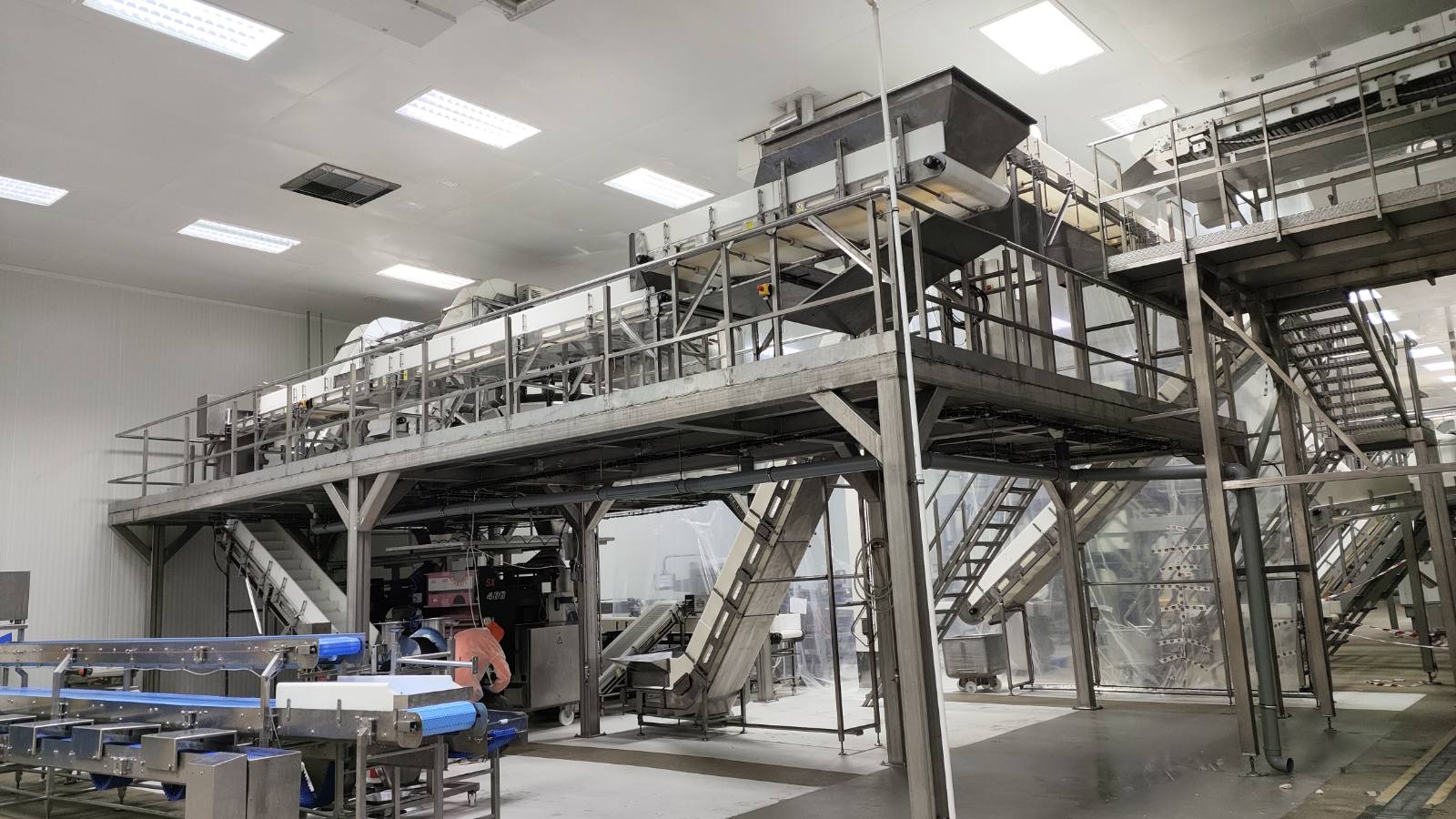
In 2023, this project became KONSORT’s largest commercial order. Our engineers designed a universal conveyor system comprising 11 conveyors, automated product flow control, and specialized design features for food processing applications.
Result: a 100% increase in productivity and the capacity to process up to 3 tonnes of product per hour.
Project at a glance
| Parameter |
Value |
| Customer |
MPP “Legko”, MHP Group |
| Industry |
Food processing, meat semi-finished products |
| Year of implementation |
2023 |
| Equipment |
Universal conveyor system |
| Number of conveyors |
11 |
| Throughput |
3 t/h |
| Productivity increase |
+100% |
| Main material |
AISI 304 stainless steel |
| Control system |
PLC, automated product flow distribution |
| Key features |
Reversible, accumulation, inclined and Z-shaped conveyors |
| Food safety |
BRC and HACCP requirements, ISO 9001 and hygienic design principles taken into account |
 About the customer: MHP “Legko”, a high-tech production facility
MHP is an international company operating in the food and agricultural technology sectors and one of the leading poultry producers in Ukraine and Europe.
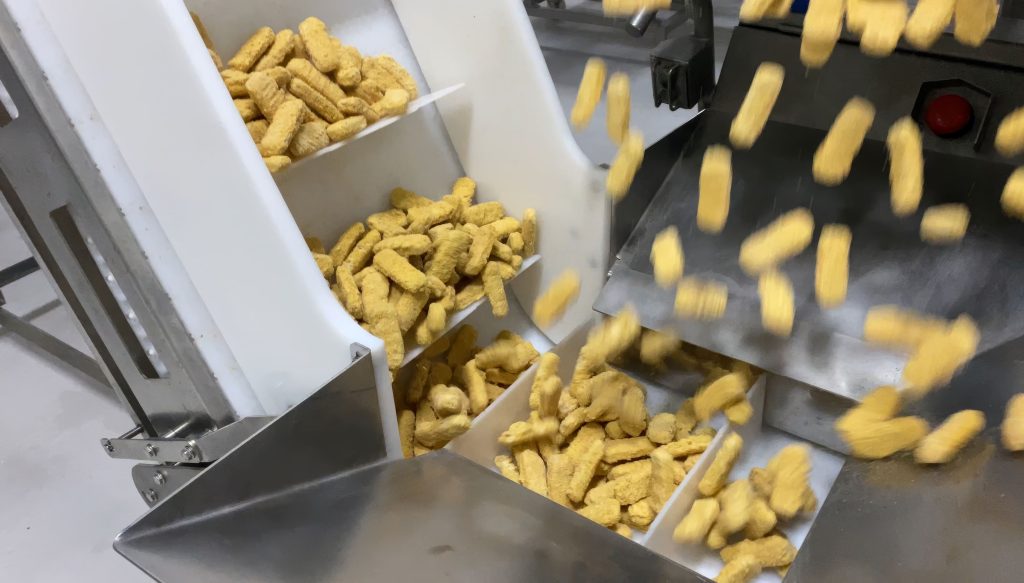
The Myronivka Meat Processing Plant “Legko” specializes in meat products and semi-finished products. For a facility of this kind, output volumes are only part of the equation. Process stability, equipment hygiene, product safety and flexible production flow management are equally important.
KONSORT began working with MHP companies well before this large-scale project.
In 2018, KONSORT manager Oleksandr Dokuchaiev began participating in the company’s tenders. Early attempts did not always result in orders, as the large agricultural holding had not yet established a working relationship with our company.
Around 2021, cooperation progressed to practical project implementation. KONSORT supplied MHP facilities with bubble washers, inspection tables and, later, customized equipment for food processing.
Gradually, we moved from supplying individual machines to developing integrated process systems.
“We won some tenders, but the orders were not awarded to us,” recalls Oleksandr Dokuchaiev. “They simply did not know us. Nobody knew we could manufacture equipment of such high quality.”
The large-scale conveyor line for MHP “Legko” became one of the results of this long-term cooperation.
Production challenge: increasing throughput and ensuring controlled meat product flow
At facilities producing meat semi-finished products, efficiency depends on the coordinated operation of every processing area.
Products must reach the next processing stage on time, avoid unwanted accumulation points and be distributed evenly between production routes.
At the same time, the load on individual units may change throughout a shift.
KONSORT’s task was to develop a conveyor system capable of transporting meat semi-finished products, changing their direction of movement, temporarily accumulating products and feeding them to subsequent processing stages, including packaging.
Key requirements:
- Increase production throughput.
- Handle up to 3 tonnes of product per hour.
- Provide controlled product distribution between process units.
- Allow the direction of movement to change depending on the load at individual production areas.
- Integrate the equipment into the customer’s existing infrastructure.
- Ensure safe operation and convenient personnel access.
- Account for equipment sanitation requirements after production shifts.
- Use materials and components suitable for food processing.
The customer therefore needed more than a collection of separate conveyors. The requirement was for a unified internal production logistics system.
Engineering solution: 11 conveyors integrated into one process system
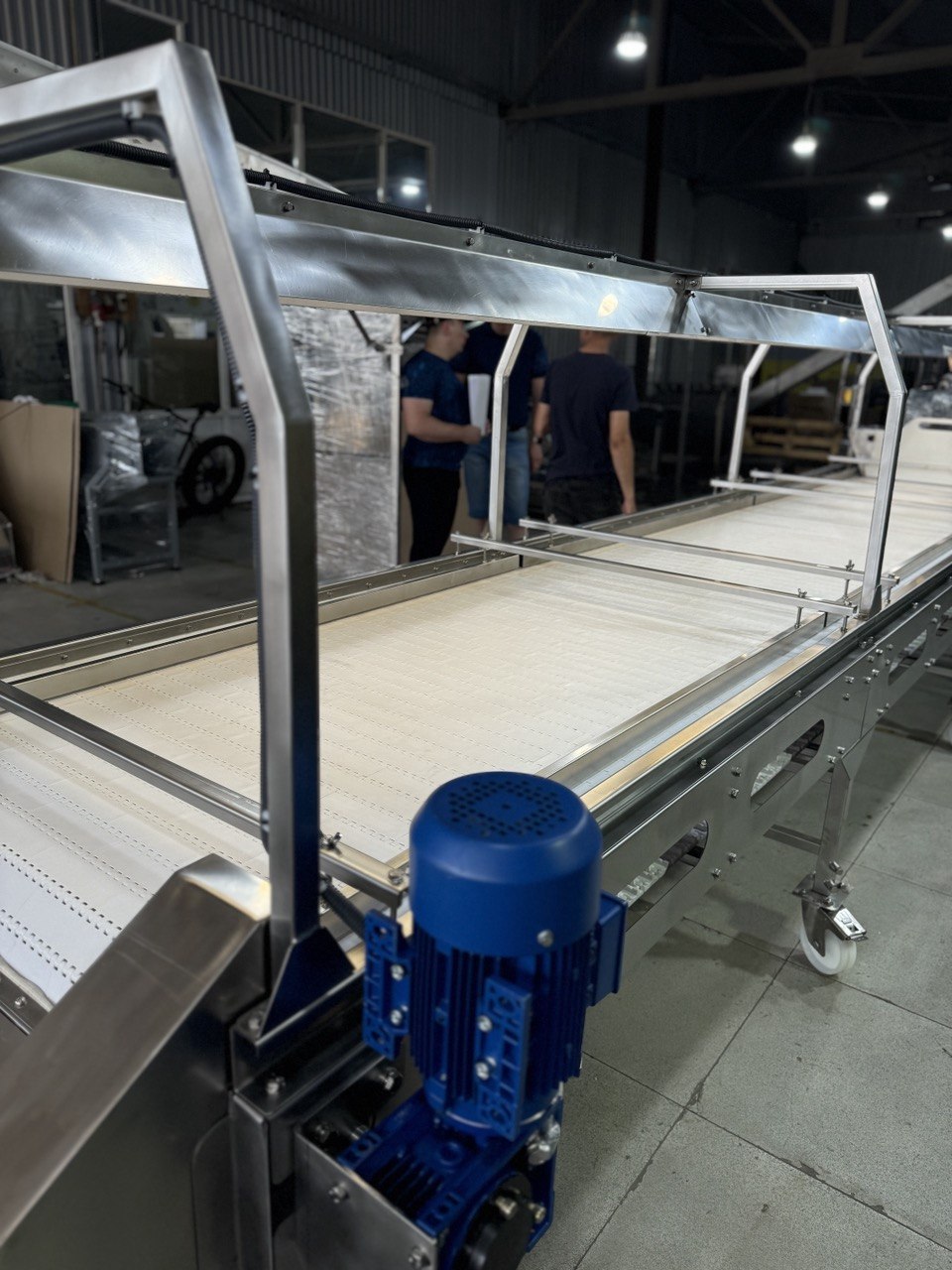
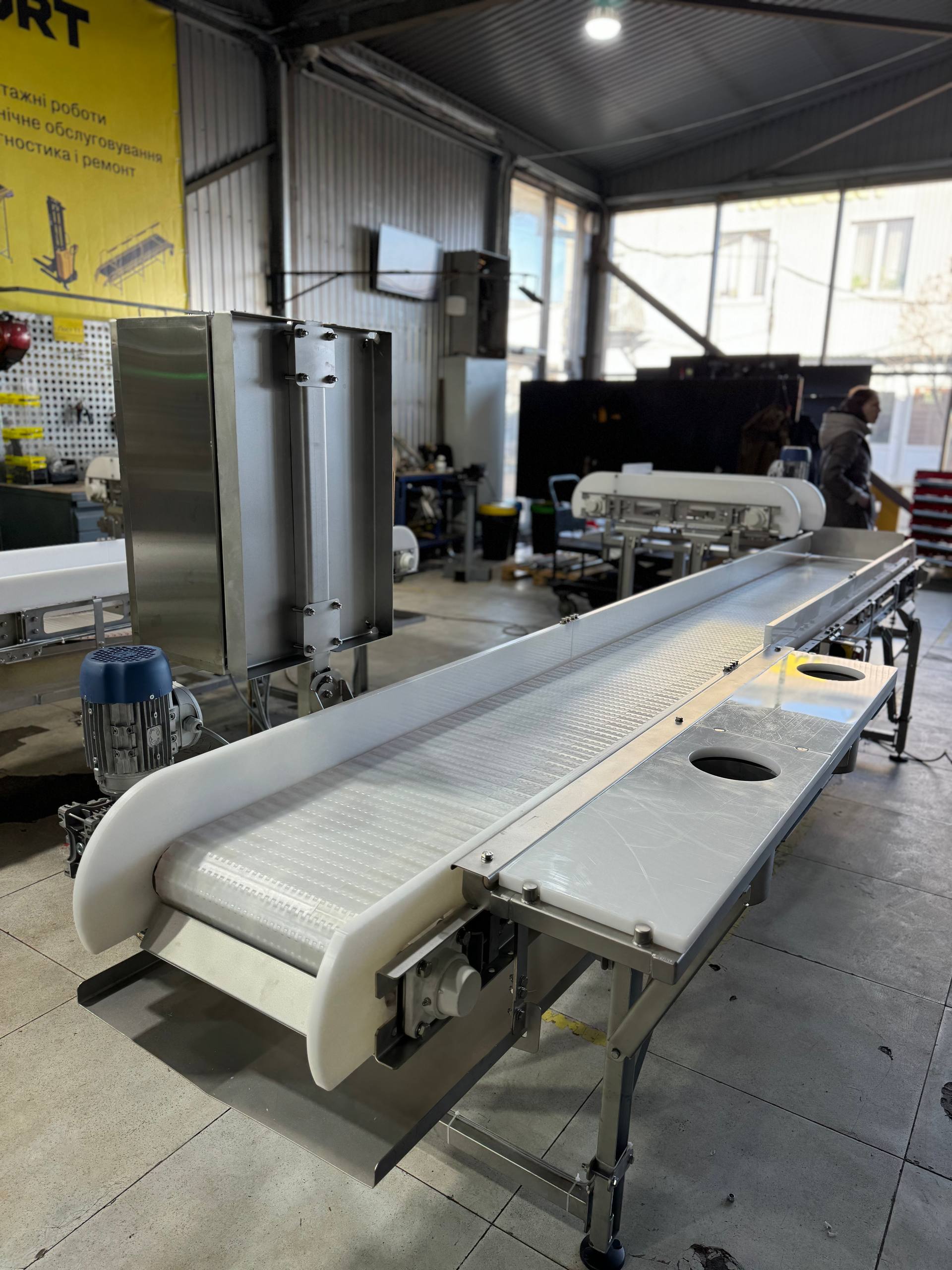
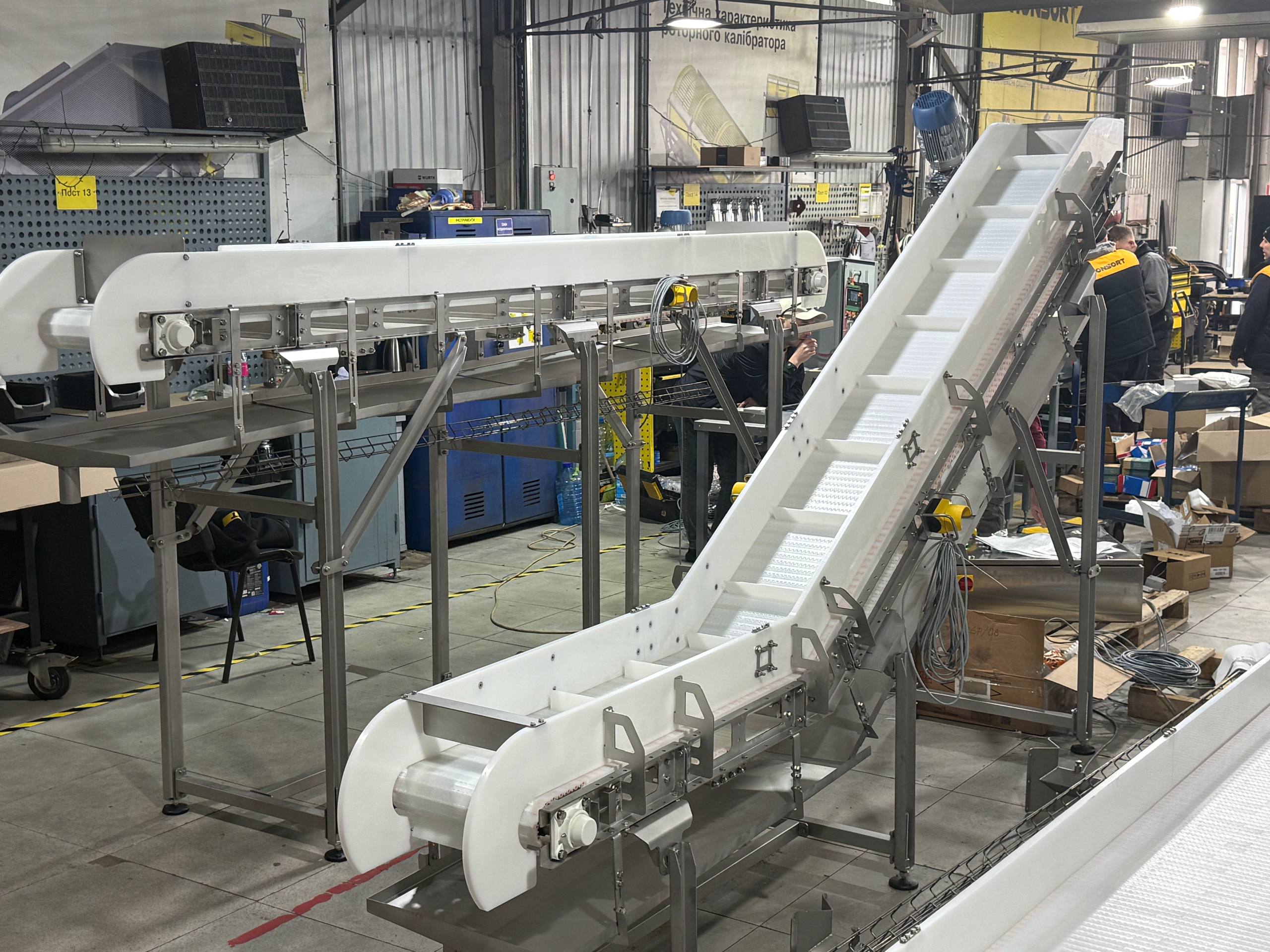
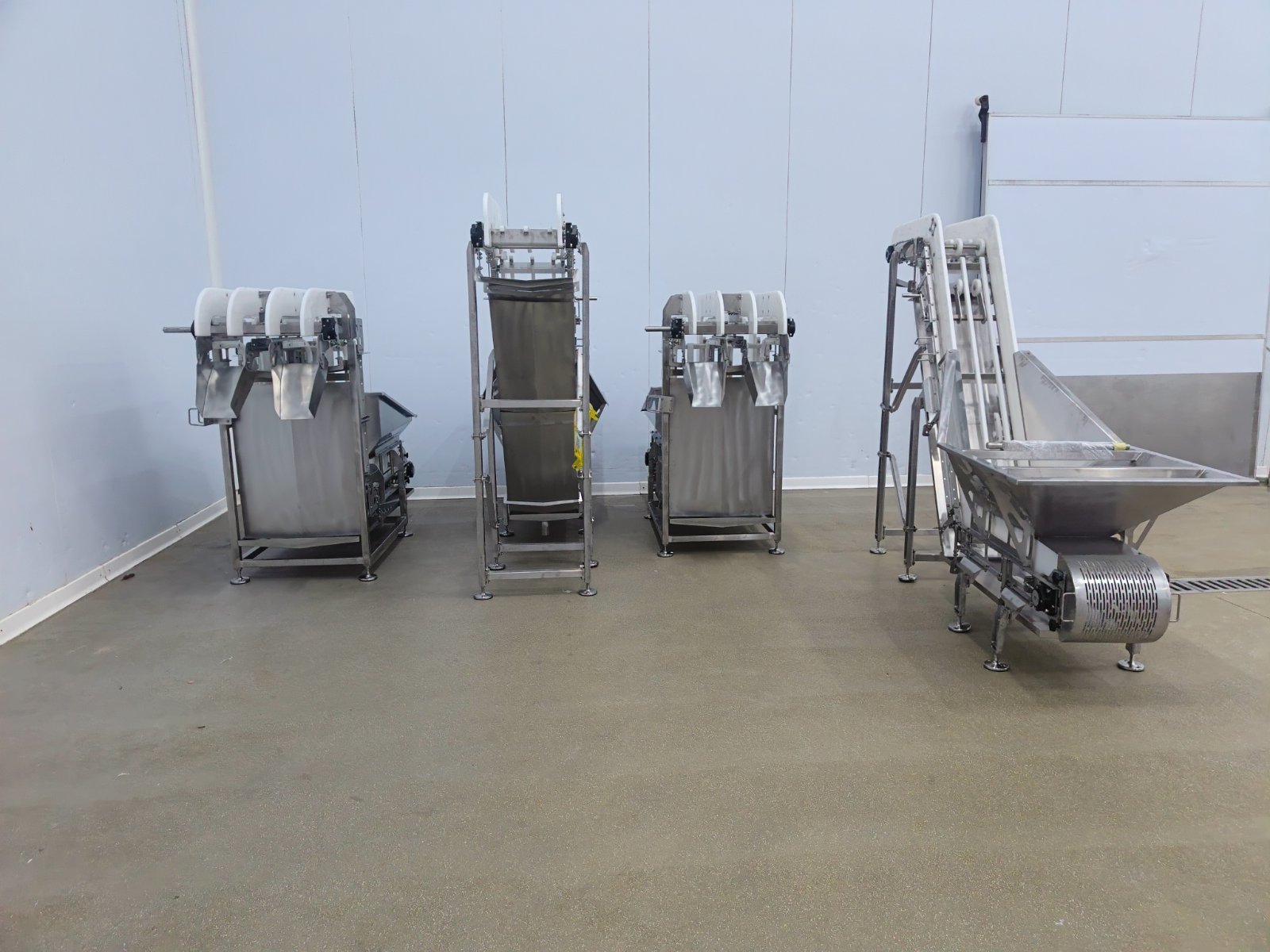
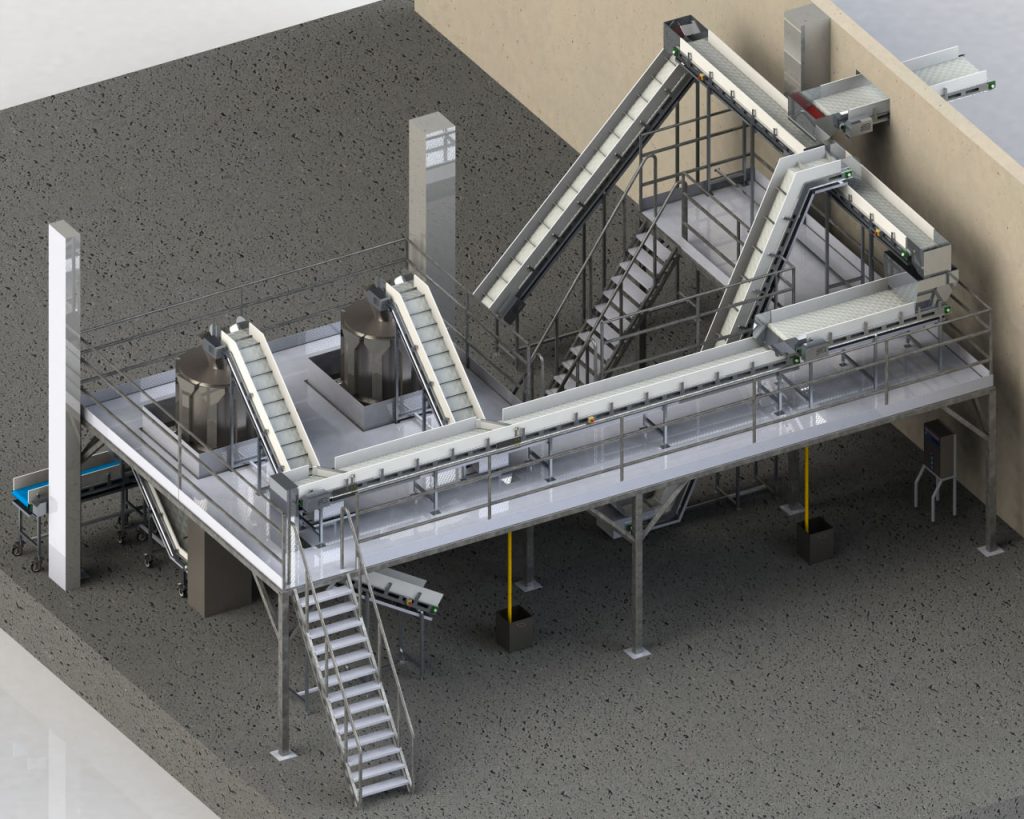
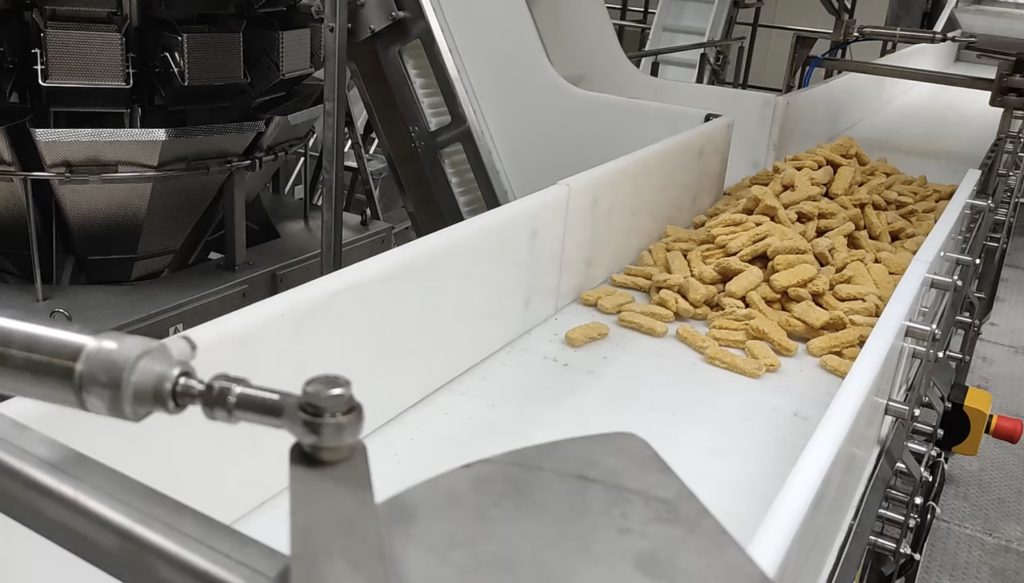
KONSORT developed a universal line consisting of 11 conveyors in different configurations.
Their design and functions were determined by the layout of the processing areas, the characteristics of meat product handling and the need for automated flow distribution.
During the design stage, the engineers considered equipment positioning, conveying directions, product transfer points and access for maintenance.
Conveyor line configuration
The system includes conveyors with different functions:
- Reversible belt conveyor. Changes the direction of movement in response to control system signals.
- Accumulation conveyor. Temporarily accumulates products to coordinate the operation of individual processing areas.
- Flow-diverting conveyors. Transfer products between conveyors and direct them along the specified process route.
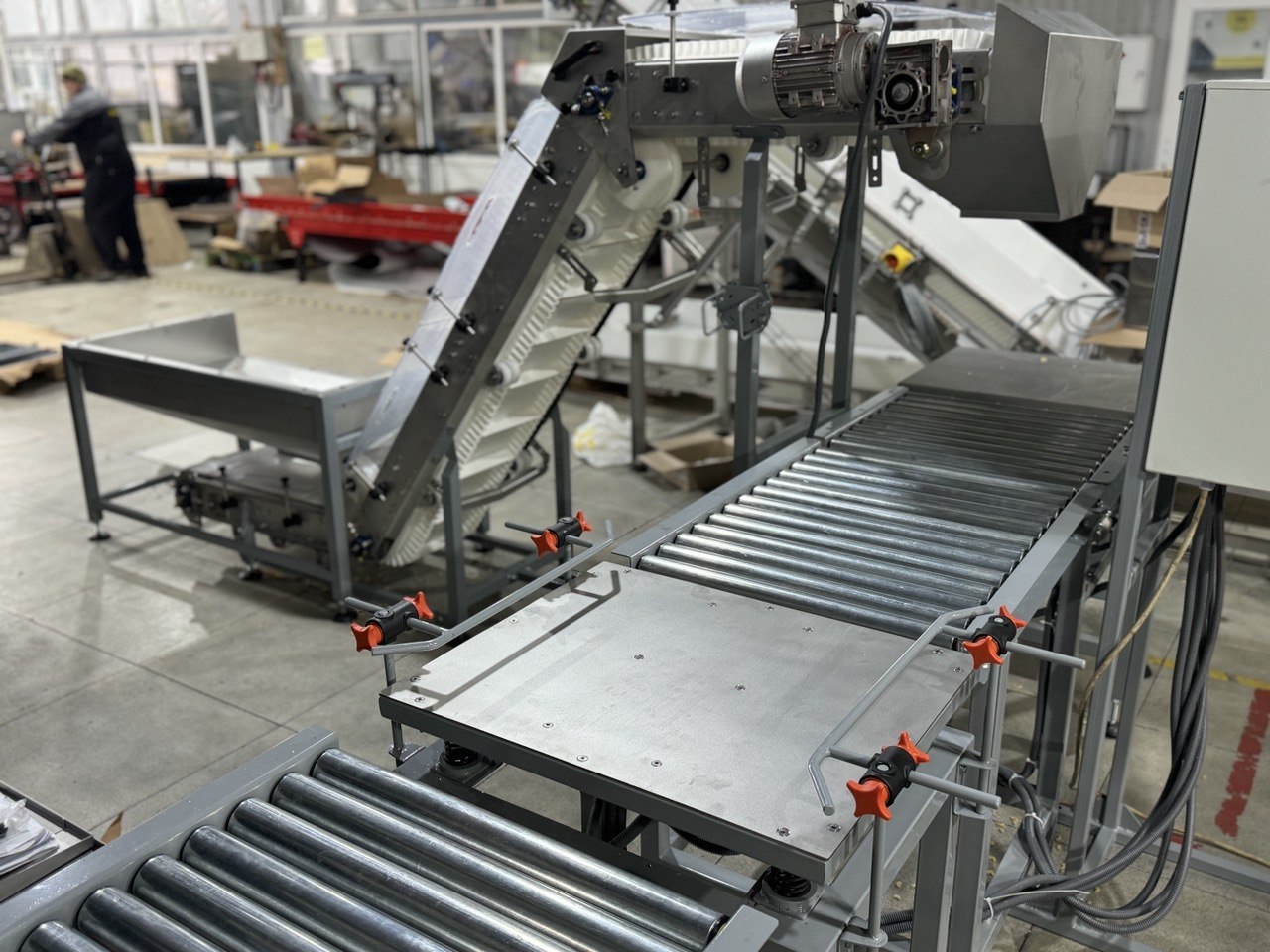
- Conveyor feeding vibratory equipment. Transfers products to the next process unit.
- Conveyor mounted on a pivoting fork. Features a braking mechanism used in the relevant positioning or direction-changing unit.
- Inclined conveyors. Transfer products between areas at different elevations.
- Z-shaped conveyors. Move products between process levels and receive products from adjacent equipment, including a mobile tipping loader.
Combining these conveyor types made it possible to create an integrated product route tailored to the facility’s requirements.
How the system works: automated product distribution between processing areas
The system is designed for continuous transportation of meat semi-finished products, with the ability to redirect flows according to production requirements.
Products enter the receiving sections of the conveyor system, pass through conveying and distribution units, and are then transferred to subsequent stages of the production process.
Overall process sequence:
Product feeding → conveying → accumulation / redirection → transfer between process levels → feeding to the next production operation or packaging.
The key feature is flow control based on the loading of individual units.
A programmable logic controller (PLC) enables the system to change product conveying directions according to the programmed operating logic.
This provides greater flexibility in product feeding and allows the conveyors to operate in coordination with adjacent processing equipment.
Control system: PLC, variable frequency drives and manual operation
An automated control system is one of the most important components of the line.
A dedicated electrical control cabinet integrates the control of conveyors, drives and other system components.
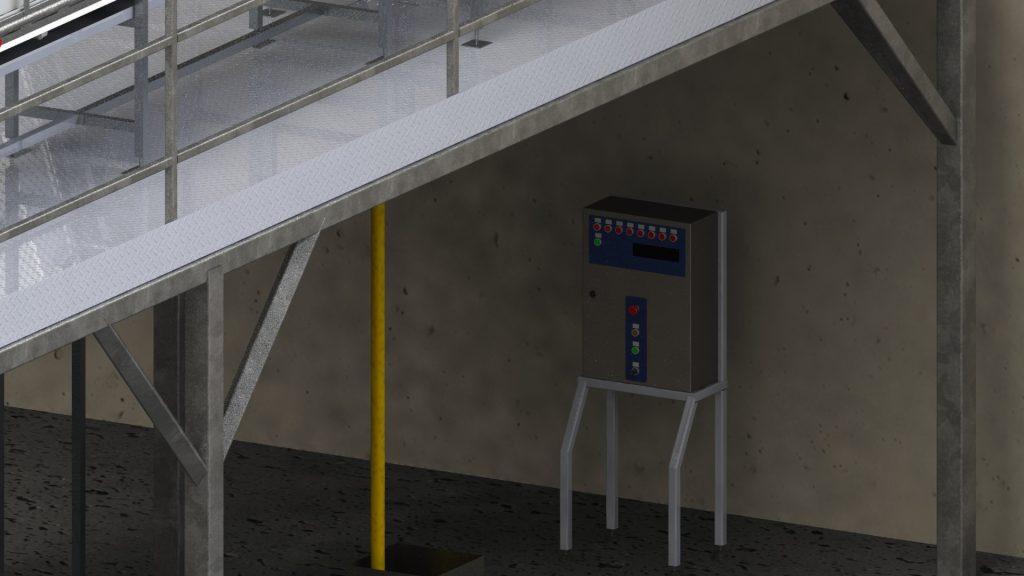
| Component |
Manufacturer / specification |
| Control cabinet |
Rittal |
| Cabinet material |
Stainless steel |
| Ingress protection rating |
IP65 |
| Push buttons and switches |
EATON |
| Drive cables |
ÖLFLEX |
| Variable frequency drives |
Danfoss |
| Automation |
Programmable logic controller |
| Operating modes |
Automatic and individual manual control |
Automatic mode runs the conveyor system according to a predefined program, including flow direction control based on the loading of process units.
Manual mode allows each conveyor to be controlled individually. This is important for commissioning, inspection and maintenance.
Variable frequency drives control the motors, allowing conveyor operating parameters to be adjusted to meet process requirements.
The documentation also provides for customer approval of the conveyor start-up sequence, control locations and electrical cabinet installation position.
Personnel safety: guards, side guides and emergency stops
In food processing, equipment safety involves several aspects: protecting workers, preventing foreign objects from entering the product and minimizing risks during maintenance.
The design therefore incorporates a range of technical safeguards.
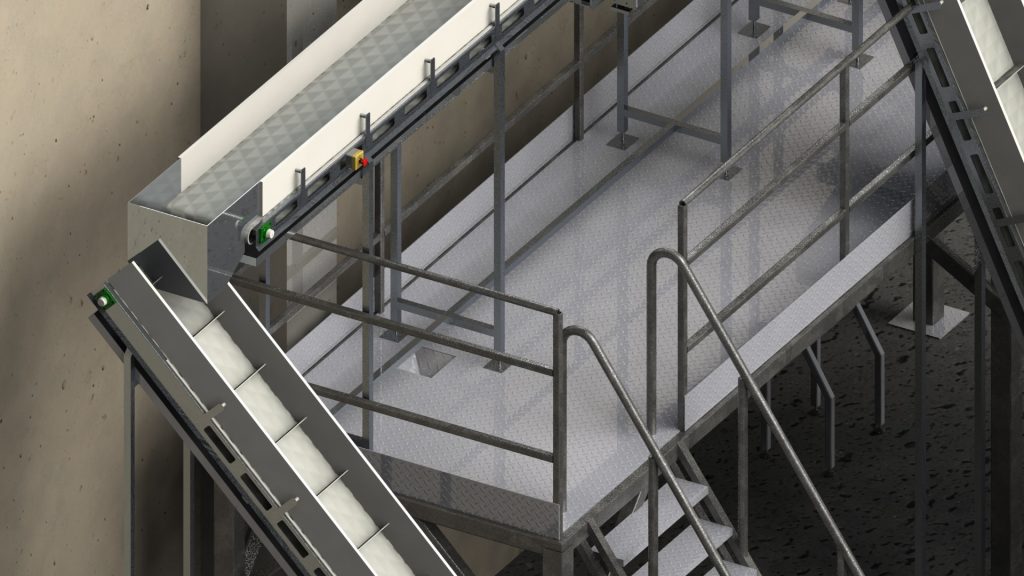
Emergency stops
Emergency stop buttons are provided for the conveyors and the control cabinet.
According to the project logic, activating an emergency stop brings the line to a stop unless an alternative sequence has been agreed in the technical specification.
This enables personnel to respond quickly to hazardous situations.
Side guides and transfer chutes
Conveyor side guides and transfer chutes are designed to keep products within the conveying system.
They help minimize the risk of products falling off during transfers between conveyors.
The technical documentation specifies wear-resistant PE 1000 polymer for the side guides.
Motor protective guards
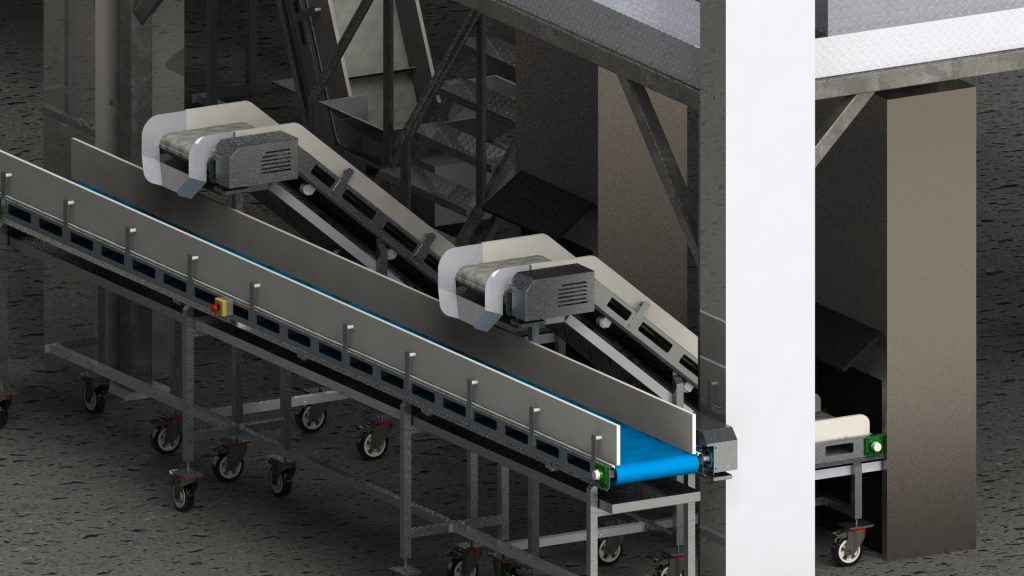
Conveyor drives are designed to be enclosed by metal protective guards.
These guards serve several purposes: restricting access to moving components, reducing product particles reaching drive assemblies and allowing the necessary cleaning to be performed.
According to the technical specification, the electric motors have an IP65 protection rating.
Protection of other mechanical and electrical components
The design also includes protective bearing caps, cable routing through dedicated trays, finished edges and other features intended to ensure safe operation.
Protective trays are provided to collect potential lubricant leakage from drive assemblies.
Particular attention was paid to pneumatic slide gates. Their smooth operation is intended to prevent products from being suddenly pushed beyond the conveyor boundaries.
Food safety: AISI 304 stainless steel, Intralox belts and hygienic design
For MHP “Legko”, high throughput alone was not enough. The conveyor system also had to be adapted to the operating conditions of a meat processing facility.
The equipment needed to withstand regular sanitation, provide access to surfaces for cleaning and minimize the risk of product contamination.
AISI 304 stainless steel
AISI 304 stainless steel, widely used in the food industry, was selected as the primary structural material.
It offers corrosion resistance and is suitable for equipment requiring regular cleaning.
The technical documentation also specifies stainless or corrosion-resistant materials for metal fasteners, shafts and other components.
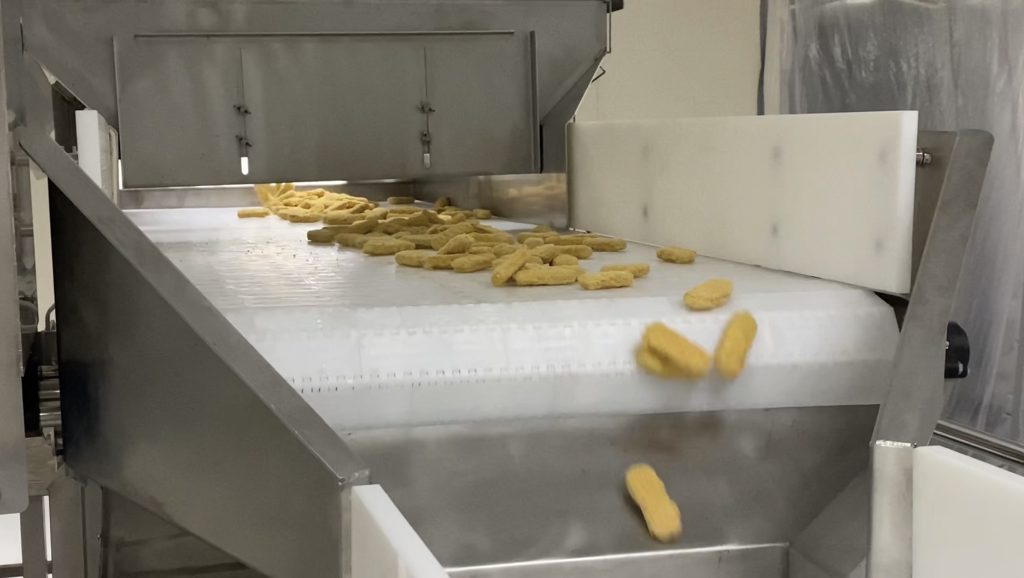
Food-contact conveyor belts
The specification includes Intralox conveyor belts suitable for contact with food products.
Belt material selection is particularly important when manufacturing meat semi-finished products, as equipment surfaces may come into direct contact with the product.
Design for regular sanitation
The design accounted for the need to clean the equipment after every production shift.
The following features were incorporated:
- Inspection windows in the frames to provide access to internal surfaces.
- Quick-release protective drive guards.
- Materials resistant to the relevant cleaning media.
- Design features that help prevent product residue from accumulating.
- Access to components requiring sanitation.
The technical requirements were developed with reference to EN 1672-2:2020, which addresses hygiene requirements for machinery used in the food industry.
The specification also identifies certain acidic and alkaline cleaning agents that may be used. However, the specific concentrations, temperatures and sanitation procedures must comply with the approved equipment operating instructions.
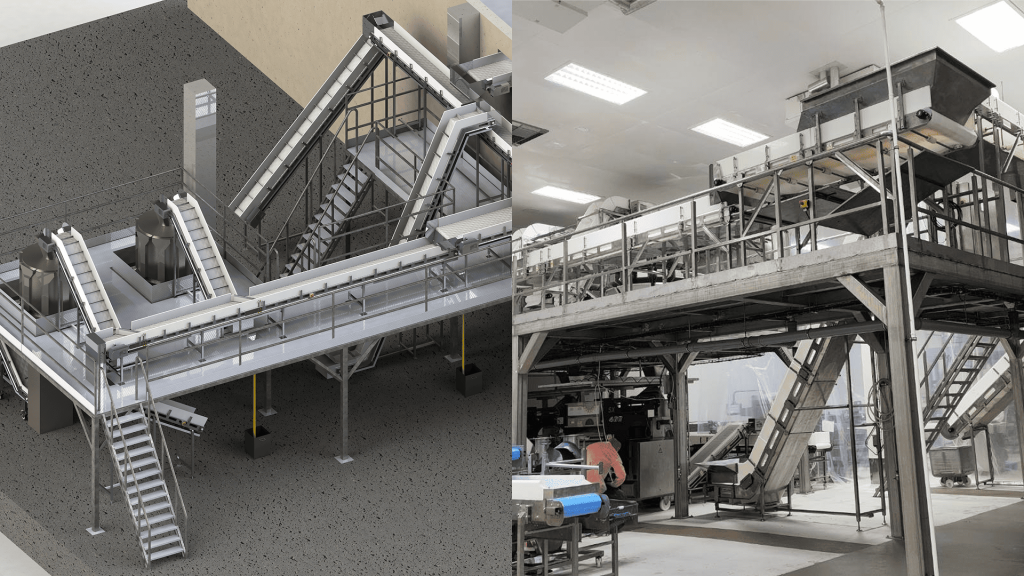
Mezzanine: a two-level conveyor system layout
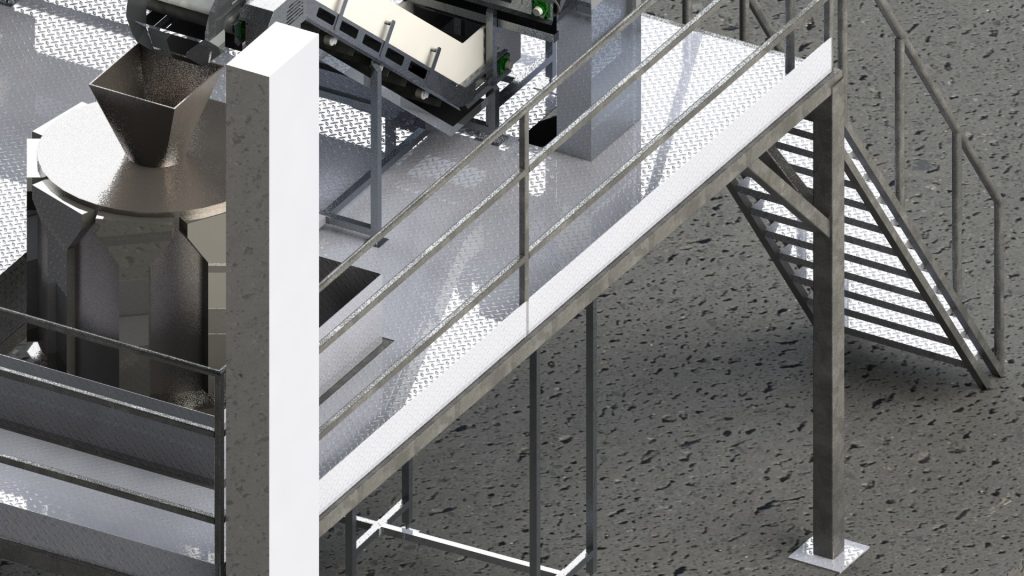
A distinctive feature of the project was the need to install not only conveyors but also an auxiliary metal structure: a mezzanine or process platform.
It provides support for positioning and servicing selected production system components at the required height.
The structure was designed with personnel safety, cleaning requirements, equipment access and installation at an operating facility in mind.
Process platform construction
The design documentation specified 3 mm thick chequered steel flooring reinforced with cross-members made from thick-walled structural tubing.
Threaded connections were used to assemble the platform without requiring major welding operations directly on the production floor.
The flooring is designed to be secured with countersunk screws.
Protective railings and edge barriers are provided around the mezzanine perimeter.
Stairs and guardrails
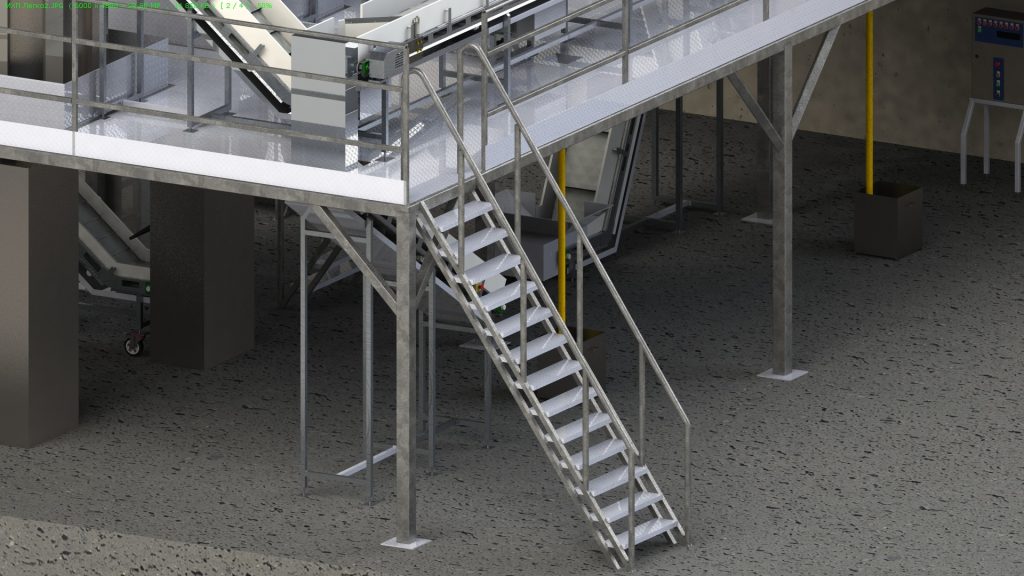
Stairs with slip-resistant surfaces provide personnel access to the process platform.
Key dimensions from the design documentation:
| Parameter |
Value |
| Step dimensions |
220 × 600 mm |
| Distance between steps |
Approximately 200 mm |
| Step thickness |
38 mm |
| Step surface |
Welded grating |
| Handrail diameter |
40 mm |
| Stair inclination |
No more than 60° |
| Guardrails |
Along the stairs and around the mezzanine perimeter |
Cleaning the process platform
The design also accounted for the potential accumulation of small product particles on the mezzanine.
To simplify cleaning, special openings with drain pipes were provided to direct product residues or contaminants to the lower level for subsequent removal.
This illustrates how an integrated project must account not only for primary production operations but also for equipment operation and maintenance over time.
From engineering design to a completed line: project implementation
KONSORT takes an integrated approach to conveyor equipment projects, covering technical specification approval, manufacturing, delivery, installation and commissioning.
For MHP “Legko”, precise compliance with the technical requirements and coordination between several conveying units were particularly important.
1. Technical requirements analysis
The KONSORT team reviewed the customer’s requirements for throughput, meat product handling, flow control, materials and integration with existing infrastructure.
Particular attention was paid to food processing requirements, equipment accessibility for washing and personnel safety.
2. Design and approval of 3D models
The engineering department developed equipment models and assembly drawings.
This stage covered conveyor positioning, process platform layout, connections to adjacent equipment and specific design features.
Where necessary, component standardization with the customer’s existing equipment was also considered.
3. Conveyor system manufacturing
KONSORT conveyors are manufactured at the company’s own plant in the Poltava region of Ukraine.
In-house engineering and manufacturing capabilities make it possible to produce customized systems, control key manufacturing operations and implement approved changes during production.
Quality control specialists inspect both completed equipment and individual parts and components.
4. Preparation for dispatch
After manufacturing and readiness inspections, the conveyors and components are prepared for transport. Particular attention is paid to protecting parts and assemblies, preventing damage during delivery and ensuring that shipping dimensions comply with the agreed requirements.
5. Mezzanine and conveyor installation
The project installation plan called for work to be carried out in a defined sequence.
First, the installation conditions at the facility were verified, the work area was prepared and the necessary auxiliary equipment was arranged.
The next steps involved installing the mezzanine, positioning the conveying equipment, routing cables and connecting the control cabinet.
The project schedule allocated 10 working days for installation, including 5 days for the mezzanine.
6. Testing and commissioning
The final stage involved checking the coordinated operation of the conveyors and control system.
Particular attention was paid to interactions between individual units, changes in conveying direction, drive control and compliance with production requirements.
Upon completion, the facility received an automated conveyor system capable of maintaining the required product flow.
Results: 3 tonnes per hour and doubled productivity
Following implementation, MHP “Legko” received an integrated conveyor system combining transportation, distribution and feeding of meat products between processing areas.
According to KONSORT, the customer’s production productivity increased by 100%, and the line can process up to 3 tonnes of product per hour.
| Parameter |
Result |
| Throughput |
Up to 3 t/h |
| Productivity increase |
+100% |
| Number of conveyors |
11 |
| Flow distribution |
PLC-based control |
| Reversible conveying |
Included |
| Integration |
MHP “Legko” production process |
| Food safety |
Specialized materials and hygienic design features |
What the facility gained
- Higher productivity. The integrated system increased product processing volumes without requiring each production area to operate as an independent conveying process.
- Flexible production flow distribution. The control system enables products to be redirected depending on the status of process units.
- Coordinated equipment operation. The conveyors form one integrated process system rather than operating as isolated machines.
- Easier cleaning and maintenance. The design accounts for the operating conditions of meat processing equipment.
- Potential for future upgrades. Individual units and control systems can be modified to meet future production requirements.
Food safety and alignment with BRC, HACCP and ISO 9001 requirements
In meat processing, conveyor equipment is an integral part of the production process. Its design directly affects production hygiene, cross-contamination risks and finished product safety. For this reason, KONSORT engineers paid particular attention to hygienic design, material selection and access for sanitation when implementing the MHP “Legko” project.
The conveyor system was designed with BRC requirements, HACCP principles, ISO 9001 quality management approaches and the European standard EN 1672-2:2020, which defines hygiene requirements for machinery used in the food industry, taken into account.
A range of engineering measures was applied to support hygiene and operational reliability:
- AISI 304 stainless steel. The primary conveyor construction material offers corrosion resistance and is suitable for regular sanitation under the specified cleaning procedures.
- Intralox food-contact conveyor belts. These belts use materials intended for contact with food products.
- Hygienic structural design. Finished welds, the absence of sharp edges, inspection windows and access to internal surfaces simplify cleaning and reduce the risk of product residue accumulation.
- Protection of drive and bearing assemblies. IP65-rated motors, quick-release metal guards and bearing protection caps limit contamination and facilitate maintenance.
- Controlled product movement. PE 1000 polymer side guides, transfer chutes and smooth pneumatic slide gate operation minimize the risk of products falling outside the conveying system.
- Provision for regular washing. The equipment is designed for sanitation after production shifts using compatible cleaning agents in accordance with the operating instructions.
Particular attention was paid to preventing contamination from technical fluids. The design includes trays to collect potential lubricant leakage from drive assemblies.
The result is a conveyor system combining throughput of up to 3 t/h with hygienic design, mechanical component protection and provisions for regular sanitation. This approach supports automated conveying in production environments with demanding food safety requirements.
From the first order to a long-term partnership with MHP
KONSORT’s cooperation with MHP demonstrates how trust in a Ukrainian manufacturer of complex industrial equipment can develop over time.
The team progressed from initial tenders and smaller orders to customized process solutions and large-scale production systems.
For major food manufacturers, equipment specifications are only part of the equation. Manufacturers must also be able to work with technical requirements, agree on changes, resolve issues and support the system after commissioning.
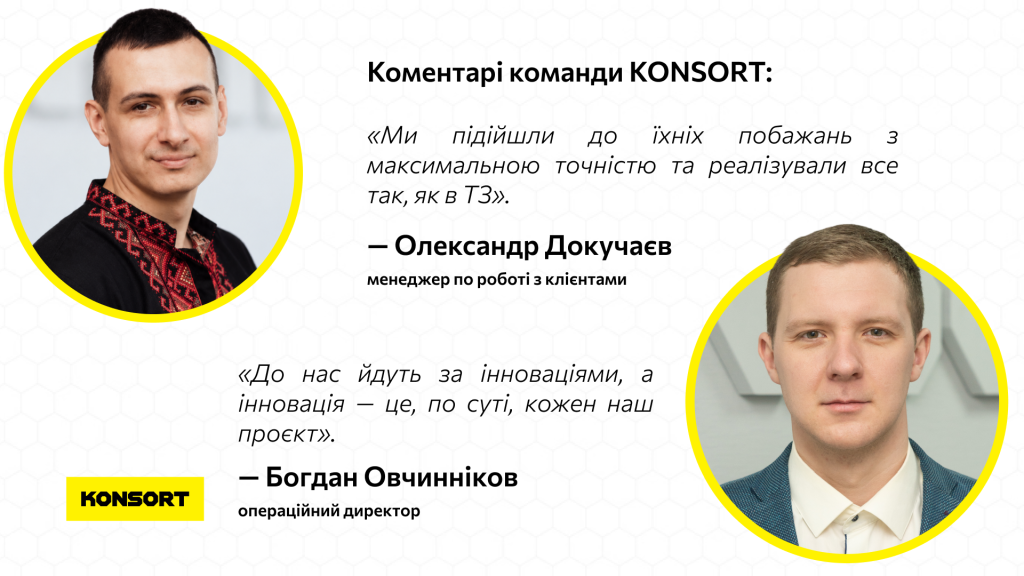
Oleksandr Dokuchaiev, KONSORT manager:
“I believe it was because we addressed their requirements with maximum precision and implemented everything as specified in the technical brief.”
Bohdan Ovchynnikov, KONSORT Chief Operating Officer:
“Customers come to us for innovation, and innovation is essentially what every one of our projects represents.”
For KONSORT, the integrated conveyor system for MHP “Legko” became an example of how a Ukrainian engineering team can deliver large-scale technological solutions tailored to the needs of an international manufacturer.
Service and technical support after commissioning
An automated conveyor project does not end with manufacturing and installation.
KONSORT provides conveyor equipment servicing, technical consultations, repairs and upgrades to production systems.
The company has service teams across Ukraine and a 24/7 hotline for equipment-related enquiries.
For facilities with continuous production processes, timely access to technical support is an important factor in maintaining operational stability.
Which facilities can benefit from a similar conveyor system?
The solution implemented for MHP “Legko” demonstrates the potential of integrated automation for food product transportation.
With the appropriate process adaptations, similar systems can be used:
- At meat processing plants to move products between processing stages.
- At frozen semi-finished product facilities to transport and feed products to packaging.
- At poultry processing plants to organize internal production flows.
- At facilities with multiple parallel production areas to distribute products automatically.
- At food processing plants with equipment arranged on two levels to transfer products between process levels.
Each system requires individual engineering based on the product type, throughput, facility layout and sanitation requirements.
Frequently asked questions about conveyor lines for meat processing
What equipment is included in a conveyor line for meat semi-finished products?
Depending on the production task, a system may include belt, reversible, accumulation, inclined and Z-shaped conveyors, flow distribution mechanisms and an automated control system. The MHP “Legko” project used 11 conveyors.
What throughput can a conveyor system provide?
Throughput depends on product characteristics, conveyor speed and the capabilities of adjacent processing equipment. In this project, the throughput is up to 3 tonnes per hour.
Can a conveyor line be integrated with existing equipment?
Yes. KONSORT designs systems around the actual location of production machinery, conveying levels, required product routes and automation requirements.
What type of steel is used for food-grade conveyors?
AISI 304 stainless steel is commonly used for equipment in the food industry. It was specified as the primary material for the MHP “Legko” project.
How are conveyors cleaned after a production shift?
The design must provide access to product-contact areas and mechanical components. This project includes inspection windows, protective guards and materials suitable for the specified sanitation procedures.
Can the system automatically change the direction of product movement?
Yes. Programmable logic controllers, reversible conveyors and flow-diverting mechanisms can be used. The control algorithm is configured according to the customer’s process requirements.
Does KONSORT provide installation and commissioning?
Yes. KONSORT delivers integrated projects that may include engineering, manufacturing, delivery, installation, control system configuration and ongoing service.
Need to automate food product transportation, sorting or packaging?
Every production facility has its own requirements, including throughput, factory layout, the number of processing stages and equipment specifications.
KONSORT designs conveyor systems around specific production tasks rather than relying on a universal template.
Our engineers can help determine the optimal line configuration, select equipment, organize product transportation and integrate automation into an existing production process.
Send us your product specifications, required throughput and a layout of your production area.
Discuss your production requirements with a KONSORT engineer and receive a preliminary technical assessment.