
Warehouse Automation: Building an Efficient Transportation and Sorting System
A modern warehouse is no longer just a space for storing racks filled with boxes and pallets. It is a dynamic hub where cargo processing speed, order picking accuracy, and space utilization directly affect business profitability.
With the growth of e-commerce, expanding product lines (SKU), and increasing demands for delivery speed, manual material handling becomes the primary bottleneck. Common challenges arise: delays during order picking, human error, workplace injuries, and high labor costs.
The solution is warehouse automation. However, automation is not merely purchasing an individual conveyor or sorter. It is building an integrated engineering ecosystem that connects all warehouse zones: from receiving to shipping.
Key Facts & Industry Statistics: Why Automation Is Inevitable
-
60–70% of a warehouse picker’s time is spent walking between racks rather than picking items. Implementing conveyor systems eliminates these unproductive trips.
-
The Cost of an Error: According to Logistics Bureau, the average cost of a manual picking error (returns, re-shipping, re-packing) ranges from $22 to $50 per item.
-
Picking Accuracy: Automated sorting lines and Pick-to-Light systems increase order accuracy up to 99.9%, whereas manual picking rarely exceeds 96–97%.
-
Global Trend: According to Grand View Research, the global warehouse automation market grows by an average of 14.8% annually, projected to exceed $50 billion in the coming years.
-
Return on Investment (ROI): On average, investments in KONSORT warehouse conveyor and sorting lines pay back within 12–18 months through reduced labor overhead and lower return rates.
Viewing the Warehouse as a Unified Technological Flow
A frequent mistake is solving operational bottlenecks in isolation. For instance, installing a high-speed weighing station while relying on manual transport to the picking area creates congestion: items are weighed quickly but pile up before the next stage.
When designing an automated warehouse system, KONSORT engineers focus on continuous flow principles. Automation should seamlessly integrate the following key stages:
Receiving & Unloading → Identification & Labeling → Transport to Storage → Order Picking → Sorting → Shipping
Comprehensive line design aligns:
-
Conveyor line speeds across all sectors;
-
Throughput capacity at merging and branching points;
-
Dimensional and weight constraints of packages;
-
Integration with enterprise WMS/ERP systems.
Equipment for Warehouse Automation
1. Receiving & Primary Conveyance
At the receiving stage, goods must be unloaded rapidly and transferred deep into the facility.
-
Telescopic Belt Conveyors: Extend directly into truck trailers or shipping containers, accelerating unloading by 2–3 times.
-
Powered Roller & Belt Conveyors: Ensure stable movement of boxes, totes, and crates along main warehouse arteries.
👉 Learn more about logistics conveyors: View KONSORT Belt Conveyor Catalog
2. Dimensioning, Weighing & Scanning (DWS Systems)
For automatic data capture, inline DWS systems are installed on main lines. They measure dimensions, weight, and scan barcodes on moving items at speeds up to 2.5 m/s without stopping the flow.
3. Inter-Zone Elevation & Transport
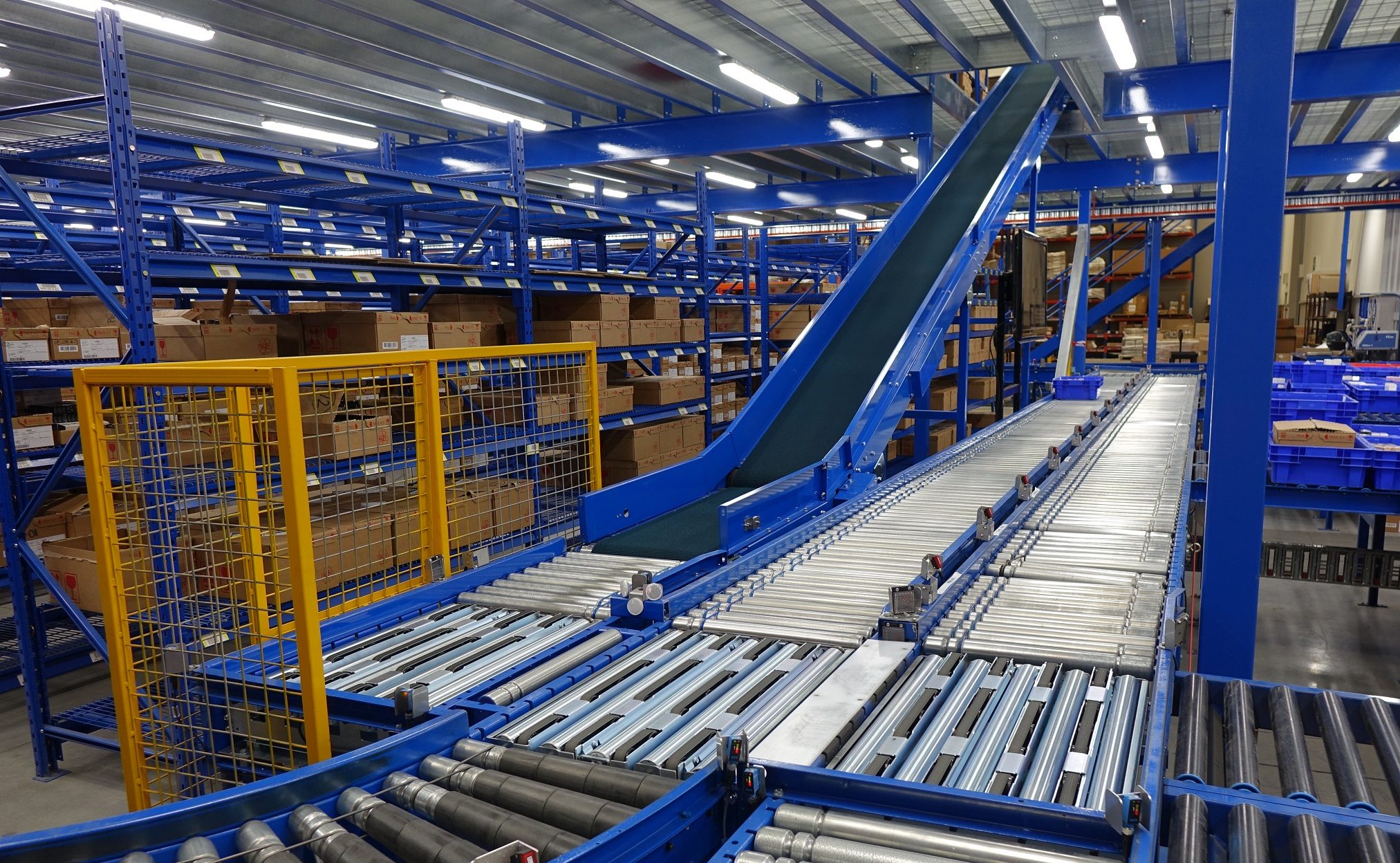
For multi-level warehouses or mezzanines, specialized vertical transport equipment is utilized:
-
L-Shaped & Z-Shaped Conveyors: For inclined item elevation.
-
Vertical Reciprocating Conveyors (VRCs): For rapid transfer of pallets or totes between mezzanine floors.
👉 Solutions for multi-floor logistics: Vertical and Inclined Conveyor Systems by KONSORT
4. Automated Sorting Lines (Sorters)
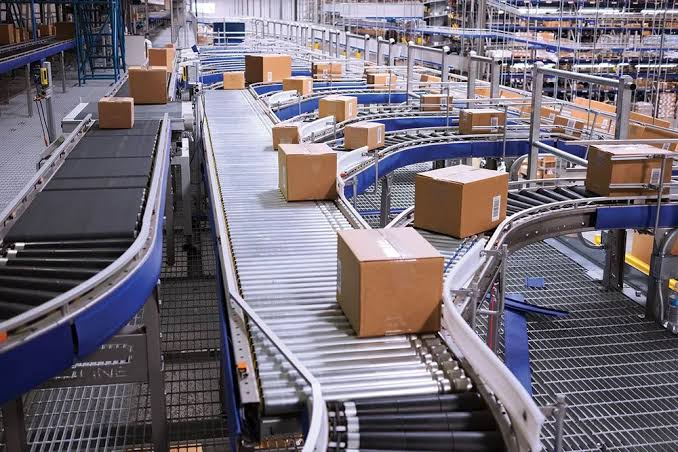
The core of any distribution center or logistics hub. Sorting lines route item streams by destination (zip codes, delivery routes, storage zones) at speeds from 1,500 to over 8,000 parcels per hour.
KONSORT Sorter Types:
-
Pusher / Diverter Systems: Designed for rigid boxes and crates.
-
Pop-Up Wheel/Roller Sorters: For high-speed box sorting.
-
Cross-Belt / Tilt-Tray Sorters: Engineered for small items, apparel, mail, and irregular packages.
Automation Features by Warehouse Type & Product Category
Equipment construction and materials depend directly on cargo type and operating environment.
| Warehouse Type / Sector | Cargo Specifics | Required Equipment | Key Considerations |
| E-commerce & Fulfillment | Small/medium boxes, polybags, high SKU count | High-speed sorters, roller conveyors, gravity flow racks | System flexibility, scanning accuracy, peak load handling |
| Pharmaceutical Warehouse | Small boxes, blister packs, medication | Modular belt conveyors, gentle sorters, Pick-to-Light systems | High tracking precision, gentle handling, hygiene compliance |
| FMCG & Food Operations | Crates, shrink-wrapped trays, bottles | Slat & modular belt conveyors, automated palletizers | Moisture protection (IP65/IP67), stainless steel builds |
| Cold Storage / Freezers | Frozen & chilled items | Low-temperature specialized conveyors | Freezer-grade lubricants, cables, and electronics (down to -30°C) |
| Industrial & DIY Storage | Heavy boxes, oversized items, pallets | Heavy-duty roller conveyors, pallet chain conveyors | High load-bearing capacity, wear resistance |
Calculating Warehouse Line Capacity
To prevent system bottlenecks, engineering calculations must target peak throughput, not daily averages.
Example: A warehouse processing 12,000 boxes per 8-hour shift:
Average Throughput: 12,000 units / 8 hours = 1,500 units/hour (25 units/min)
In real-world operations, arrival flows fluctuate. To accommodate peak spikes (e.g., simultaneous truck unloading), a peak factor K = 1.3 – 1.5 is applied.
Design Peak Throughput: 1,500 × 1.4 = 2,100 units/hour (35 units/min)
Line belt speeds, pneumatic actuator response times, and DWS scanner performance must be rated for 2,100 units/hour.
7 Essential Parameters for Selecting Warehouse Equipment
-
Cargo Characteristics: Dimensions (Min/Max length, width, height), weight (grams to metric tons), packaging type (cardboard, plastic tote, polybag, pallet).
-
Peak Throughput: Units processed per hour during maximum volume periods.
-
Facility Layout: Length, width, clear height to trusses, column placement, forklift aisles, and emergency exits.
-
Sorting Logic: Number of sorting destinations and routing algorithms.
-
Environmental Conditions: Operating temperature (dry storage, chilled, freezer), humidity, dust levels.
-
Software Integration: WMS, ERP, or TMS system integration via Modbus, Profinet, REST API, etc.
-
Scalability: Modular expandability for future throughput growth without total system redesign.
Common Pitfalls in Warehouse Automation
-
Buying Modular Conveyors Without a Master Plan: Standalone conveyor sections from different suppliers are difficult to integrate into a unified system with centralized control logic.
-
Ignoring Packaging Details: Attempting to convey soft polybags on standard roller conveyors leads to jams and operational halts.
-
Lack of Accumulation Buffers: If a downstream station (e.g., packing) slows down, lack of zero-pressure accumulation conveyors causes upstream line blockages.
-
Overlooking Service & Spare Parts: Sorter downtime during peak season incurs massive costs; choosing a local manufacturer with dedicated service guarantees operational continuity.
Estimated Warehouse Automation Equipment Pricing
Pricing depends on total line length, level of automation, sensor specifications, and software complexity.
| Equipment Type | Purpose | Key Specifications | Estimated Cost (From) |
| Roller Conveyor | Box & tote transportation | Powered/gravity, width from 400 mm | from €1,100/m |
| Mainline Belt Conveyor | Inter-zone material movement | Custom length & speed | from €2,100 |
| Telescopic Conveyor | Rapid truck loading/unloading | Extendable arm up to 18 m | from €10,500 |
| Automated Sorter | High-speed item routing | Capacity 1,500 – 6,000+ units/hr | from €24,500 |
| Complete Turnkey System | Full facility automation | Design, installation, WMS integration | Custom Quote |